1. The short answer
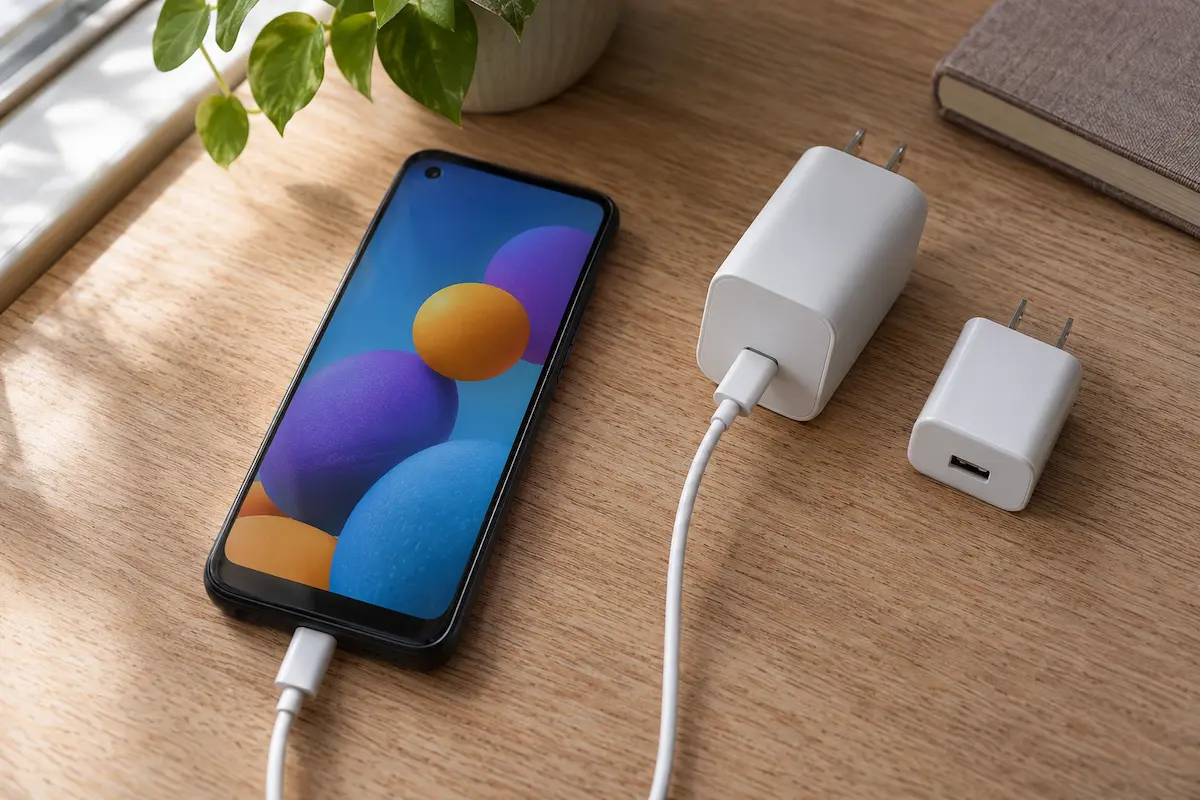
On a Galaxy A21, a 65W charger and a 15W charger should fill the battery at practically the same speed. The phone decides how much power it takes, and the A21 tops out at 15W. GSMArena lists it ↗ with a 4,000 mAh battery and 15W wired charging.
The 65W charger is not harmful or wasted. Its extra capacity simply goes unused. Think of a garden hose connected to a huge water main: the hose still delivers only what its own width allows. A bigger main changes nothing.
There is one catch, covered in section 7. A charger that does not speak the same fast-charging language as the phone can make charging slower, not faster.
2. What the watts on a charger really mean
Watts measure power. You get them by multiplying volts by amps. A basic 5V charger giving 2A delivers 10W. A phone fast-charging at 9V and about 1.7A gets roughly 15W. A 65W laptop-class charger might offer 20V at 3.25A.
The key point: the number on the box is a ceiling, not a push. It is the most the charger is able to offer. It does not mean the charger forces that much into the phone.
If you read the tiny print on a charger, you will see several pairs such as 5V/3A, 9V/3A and 20V/3.25A. These are supported output combinations; the actual voltage and current depend on the charging protocol and what the phone requests.
The cable matters too. Every cable has a current rating, and a basic one may be built for only 2 or 3 amps. For a 15W phone that is plenty. For high-wattage laptop charging, you would need a cable made for it. Mixing a strong charger with a weak cable never gives you the headline number.
3. How the phone and charger agree on a speed
Before fast charging begins, the charger and phone negotiate a compatible power level. The charger lists what it can do. The phone requests a level it can safely use. If the battery is warm or nearly full, the phone asks for less.
With compatible, properly functioning equipment, the phone controls the power it draws. A higher-rated charger does not force its maximum output into the phone.
4. What the Galaxy A21 can accept
The Galaxy A21 has a 4,000 mAh battery and supports 15W wired charging. It has no wireless charging and no 25W "Super Fast Charging" mode, which newer Galaxy models use.
In theory, a 4,000 mAh battery holds roughly 15 watt-hours. Dividing that energy by 15W gives a theoretical minimum of about an hour, but it is not a realistic full-charge estimate. Input power is not constant, charging has losses, and the phone reduces power as the battery fills.
15W charger
Offers up to 15W. The phone can draw up to 15W.
65W charger
Offers up to 65W. The phone can still draw only up to 15W.
5. What to expect in a real charging test
I could not find a published stopwatch comparison of a 65W and a 15W charger on the Galaxy A21 itself, so here is what related evidence suggests.
The Galaxy A21s is a close relative with a larger 5,000 mAh battery and the same 15W limit. GSMArena found ↗ that its included 15W charger restores about 26% of an empty battery in 30 minutes. PhoneArena reported more than four and a half hours for a full 0 to 100% charge with the same kind of charger.
Those numbers show that the phone, not the charger, sets the pace. If you swap in a 65W charger on a 15W phone, expect the same charging curve, give or take normal variation from temperature, background activity and cable quality. A few minutes of difference over a full charge would not prove one charger is faster.
If you do your own test, compare the same battery range with both chargers, for example 20% to 80%. Charging typically slows as the battery approaches full, so a 20% to 80% comparison makes the results easier to interpret.
Heat is the other quiet factor. A phone that warms up in a case or on a sunny windowsill reduces its own charging power to protect the battery. If one charger runs on a cool desk and the other on a hot afternoon, the result tells you about the room, not the charger. Run both tests in the same place, at about the same room temperature, to keep the comparison honest.
6. Why a 65W charger is still worth having
A high-wattage charger is a good buy when it serves more than one device. Many 65W models are small GaN chargers that can run a laptop, a tablet and a phone from one plug. Your phone draws no more than its supported charging power.
It also helps if you upgrade later. A future phone rated for 45W or 65W may also benefit, provided the charger supports its required charging protocol and output profile. In that case the strong charger is an investment, not a waste.
What it will not do is make an older 15W phone charge faster today. Pay for watts only if a device you own can actually use them.
7. When a 65W charger can be slower
Fast charging works only if the charger and phone share a protocol, which is a set of agreed rules for the conversation. Samsung phones have used their own Adaptive Fast Charging and, on newer models, USB Power Delivery with extra features. Not every charger supports every rule.
If the phone does not recognize what the charger offers, it falls back to a safe slow level, often around 5V. The result is a "powerful" charger that charges slower than the small one in the box. This is the surprising case people notice.
Two other things can hold you back. A thin or worn cable limits current, and a hot phone slows itself down to protect the battery. If your lock screen says "Charging" instead of "Fast charging", suspect the cable or protocol first.
8. How to measure the real watts yourself
To check power during charging, use a compatible USB power meter between the charger and phone. It displays voltage, current and watts at the USB connection; this is input power, not a direct measurement of the power stored in the battery.
A fair test in five steps
1. Start both runs at the same battery level, for example 20%. 2. Keep the screen off and avoid heavy apps. 3. Use the same cable for both chargers. 4. Note the watts at 30%, 50% and 80%, and the time it takes to go from 20% to 80%. 5. Let the phone cool down between runs.
With a 15W-limited phone, either charger may briefly show input power approaching 15W under suitable conditions, but readings vary with battery level, temperature and charging compatibility. If the 65W charger consistently reads much lower, check its charging protocol and the cable before drawing a conclusion.
Quick tips
- Check your phone's maximum charging speed in its specifications before buying a charger.
- Choose a charger that lists the protocol your phone uses, such as USB Power Delivery or Samsung fast charging.
- Use a short, good-quality cable. A cheap cable can waste more speed than the charger gains.
- Charge with the screen off and the phone out of direct sun or a thick case.
- Buy a high-wattage charger only if it will also power a laptop, a tablet or a future phone.
💬 Comments