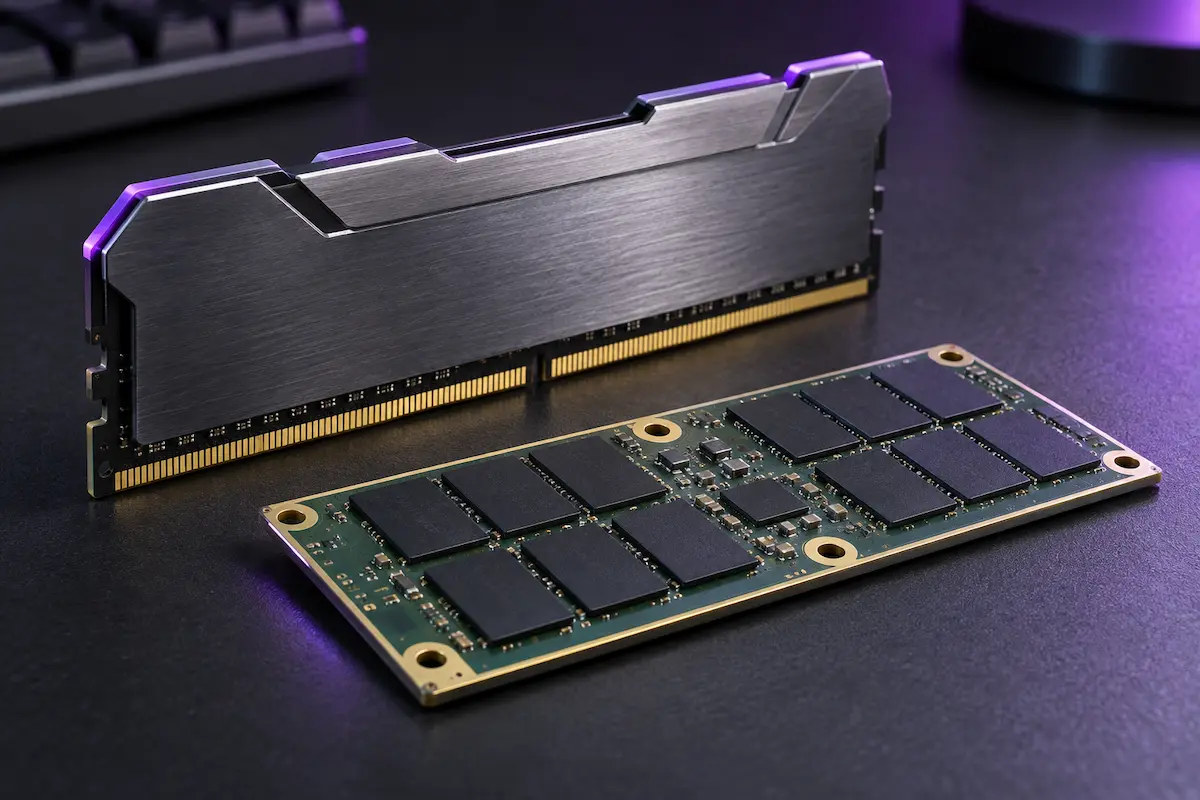
DDR6 is coming, and the headline numbers sound huge: roughly double the speed of DDR5 on paper, plus a completely new memory layout. But how much faster will it feel in a real PC?
Here is the short version. Raw bandwidth could be two to four times higher than a typical DDR5 kit, but everyday programs will gain far less, and you will not be able to buy a DDR6 desktop for a few years. Below is what we know in November 2026, what is still rumor, and what it means for your next upgrade.
Quick note: the DDR6 standard is not finished yet, so every DDR6 figure in this article is a reported target, not a final spec.
The short answer: how much faster will DDR6 be?
On paper, DDR6 should be about twice as fast as DDR5 at the top of its roadmap, and clearly faster even at launch. Reports say it will start at 8,800 MT/s and climb to 17,600 MT/s, with talk of 21,000 MT/s for overclocked modules later on.
MT/s stands for mega-transfers per second. It counts how many times per second a memory module can move a chunk of data. Higher is faster.
For comparison, DDR5 started at 4,800 MT/s in 2021, and most gaming PCs in 2026 run kits at 6,000 MT/s. Against a DDR5-6000 kit, launch-speed DDR6 is about 47% faster in raw speed. At the top of the roadmap, it is almost three times as fast.
There is a second ingredient. DDR6 is expected to use a wider data path, which means more data moves with every transfer. Put both changes together and the theoretical bandwidth of a typical desktop could be roughly 2.2 times that of DDR5-6000 at launch, and up to 4.4 times at the top speed. Section 4 shows the math.
Here is the catch. Bandwidth is not the same as the speed you feel. Most everyday programs care more about how quickly memory responds than about how much data it can move at once. So the real-world gain will be much smaller than those multiples, and it will not reach desktop buyers for a while.
Where DDR5 stands in 2026
DDR5 is the memory in nearly every new PC today. Its standard was published by JEDEC, the industry body that writes memory specs, in 2020. It reached consumers in 2021 at 4,800 MT/s.
Since then it has grown up. Mainstream kits now run at 5,600 to 6,400 MT/s, enthusiast kits pass 8,000 MT/s, and server-grade MRDIMM modules reach 8,800 MT/s. That is nearly double where DDR5 began, and it tells you something useful: a memory generation keeps getting faster for years after launch.
That matters for this comparison. When someone says "DDR6 will be twice as fast", the answer depends on which DDR5 they mean. The first DDR5-4800 kits, the common DDR5-6000 kits and the fastest overclocked kits all give different results.
For most builders, DDR5-6000 with a low latency rating (such as CL30) has been the sweet spot between performance and price. We use it as the "typical DDR5" baseline in this article.
Illustration: the Memory page in Windows Task Manager. The speed and form factor lines tell you which kind of RAM you have today.
DDR6 specs: what has been reported so far
JEDEC has not published the final DDR6 standard, and the reports keep shifting. The table shows the most commonly reported targets next to DDR5.
| Feature | DDR5 (today) | DDR6 (reported) |
|---|---|---|
| Status | Shipping since 2021 | In development, standard not final |
| Starting speed | 4,800 MT/s | About 8,800 MT/s |
| Typical speed in 2026 | 5,600 to 8,000+ MT/s | Not available yet |
| Roadmap top speed | Server modules up to 8,800 MT/s | 17,600 MT/s (21,000 MT/s talked about) |
| Subchannels per module | 2 × 32-bit | 4 × 24-bit |
| Width per module | 64-bit | 96-bit |
| Two-module desktop | 128-bit | 192-bit (expected) |
| Form factor | Classic DIMM stick | Likely CAMM2 (not confirmed) |
| Voltage | 1.1 V | Reportedly lower |
| Platforms | AMD AM5, Intel LGA1851 and others | New platforms only |
A new way to split the data
DDR5 splits each module into two 32-bit subchannels. DDR6 is reported to use four 24-bit subchannels per module. A subchannel is a small, independent lane that the memory controller can talk to at the same time as the others. More lanes let the CPU keep more requests in flight, which helps when many programs ask for data at once.
The sums are simple. Four lanes of 24 bits make a 96-bit module, compared with 64 bits for a DDR5 module. With two modules in a desktop, that would give a 192-bit path instead of today's 128-bit one.
Illustration: more, narrower lanes let the CPU keep more memory requests moving at the same time.
A new shape: CAMM2
Many reports also expect DDR6 to move away from the long stick we have used for decades and toward CAMM2, a flat module that is screwed onto the board. A flat design keeps the electrical paths short, which helps signals stay clean at very high speeds. It is also thinner, which suits laptops. This is expected, not confirmed, and desktop DDR6 might still use DIMMs.
plugs in vertically
screwed down (expected)
Illustration: DDR5 uses the familiar DIMM stick, while DDR6 is widely expected to use a flat CAMM2 module.
Voltage and efficiency
Some sources say DDR6 will run at a slightly lower voltage than DDR5's 1.1 V to save power at high speeds. Others give no firm number. Treat it as likely, but unconfirmed.
Bandwidth: the numbers behind the headline
Theoretical bandwidth is easy to work out. Multiply the speed in MT/s by the width of the data path in bytes (bits divided by eight). A standard dual-module DDR5 desktop is 128 bits wide, which is 16 bytes. So DDR5-6000 gives 6,000 × 16 = 96,000 MB/s, or 96 GB/s.
Now the same sum for DDR6-8800 with the expected 192-bit path, which is 24 bytes: 8,800 × 24 = 211.2 GB/s. At 17,600 MT/s, it doubles to 422.4 GB/s.
Theoretical peak bandwidth
Dual-module desktop, speed × bus width
DDR5 at 128-bit, DDR6 at an expected 192-bit. Calculated peak values, not benchmark results.
Two things stand out. First, the DDR6 advantage comes from two places at once: higher speed and a wider path. Second, these are ceilings, not measurements. No real program reaches theoretical bandwidth, and final DDR6 platforms may be configured differently from what reports assume.
Here is a fun comparison. One DDR6-8800 module (96 bits, about 105.6 GB/s) would deliver roughly what two DDR5-6400 modules deliver together (102.4 GB/s). That is the real meaning of the new layout: more work done per module.
Real-world speed: latency and who benefits
Latency: the number people forget
Latency is the delay between asking memory for data and receiving it. It is measured in nanoseconds (ns). Memory kits list CAS latency (CL) in clock cycles, so you need a quick formula: latency in ns = CL × 2,000 ÷ speed in MT/s.
A DDR5-6000 CL30 kit works out to 10 ns. If a DDR6-8800 kit launched at CL44, it would also land at 10 ns. That is a made-up example, but it shows the point: bandwidth can jump while the delay barely changes.
First-word latency (lower is better)
CL × 2,000 ÷ MT/s = ns
The striped bar is a made-up example, not a real kit. Calculated values, not benchmark results.
Illustration: bandwidth can double while the delay before data arrives stays almost the same.
History backs this up. Early DDR5-4800 CL40 kits had about 16.7 ns of latency, while mature DDR4-3200 CL16 kits managed 10 ns. Early DDR5 had far more bandwidth, yet the gaming gains were small at first and improved only when faster kits arrived. Expect the same pattern with DDR6: the first kits will probably shine in bandwidth-heavy work before they shine in games.
Who gains the most
Integrated graphics. A PC without a graphics card shares system memory with the GPU, so more bandwidth translates directly into smoother frame rates.
Local AI. Running language models on a CPU is limited mostly by how fast the weights can be read from memory. Wider and faster memory helps here more than almost anywhere else.
Creative and technical work. Video editing, 3D rendering, large photo batches, compression and scientific tools move huge amounts of data and can use the extra bandwidth.
Servers. Data centers are the first customers for a reason. Many cores asking for data at once is exactly where four subchannels and high bandwidth pay off.
Who gains the least
Gamers with a dedicated graphics card will see modest gains, because most games depend on the GPU and the CPU cache more than on raw memory bandwidth. Web browsing, office work and video streaming will feel the same. For these uses, the move from DDR5 to DDR6 will be nearly invisible for a long time.
When will DDR6 arrive?
Right now, DDR6 is still in development. Memory makers are reported to be building early chips, and the JEDEC standard is not final. Servers are expected to get DDR6 first, from 2027 at the earliest. Desktops and laptops come later: most estimates say 2028 to 2030, and one German analysis suggests desktops may not see it before 2030. Earlier reports pointed to 2027 for PCs, so treat every date as a target, not a promise.
Illustration: every DDR6 date is a target, not a promise.
It also needs a new platform. The memory controller lives inside the CPU, so DDR6 cannot run on today's AMD AM5 or Intel LGA1851 motherboards. Both are DDR5 only. You will need a new CPU and motherboard, and probably a new module type. There is no way to upgrade from DDR5 to DDR6 by swapping sticks.
memory controller inside
DDR5 ONLY
Illustration: the memory controller sits inside the CPU, so the memory type is tied to your platform.
If you want a deeper look at the timeline itself, read our earlier guide, DDR6 RAM: The Real Timeline, Speeds, and Whether You Should Wait.
Should you wait? Prices in 2026
For most people, no. If your PC needs memory now, living with a slow computer for two to four years is a heavy price for a platform that does not exist yet.
Prices make the choice harder in 2026. AI data centers have soaked up DRAM supply, and consumer RAM has become expensive. According to one US price tracker, the cheapest 32GB DDR5-6000 kit went from $59 in April 2025 to $429 on November 3, 2026. Team Group's CEO said on November 2 that the shortage has not peaked, and put the worst stretch between the last quarter of 2026 and the second quarter of 2027.
32GB DDR5-6000 kit (2 × 16GB)
Cheapest tracked kit, United States
Prices vary by store and change quickly. Figures based on WhereIsMyRAM US price data.
Early DDR6 will not be cheap either. New memory generations usually launch at a premium, and early DDR5 cost well above DDR4. So waiting will not automatically save you money, especially in the first year or two of DDR6.
The practical approach is simple: buy the DDR5 you actually need, and plan a full platform upgrade around 2028 or later, when DDR6 boards and processors are announced.
Quick checklist: what to do now
Buy for today. 16GB is fine for light use, and 32GB is a sensible target for gaming and creative work. In a market this expensive, do not pay for capacity you will not use.
Skip the speed premium. A DDR5-6000 kit with low latency is usually the best balance. Ultra-fast kits cost much more for gains you will rarely notice.
Check compatibility. Look at your motherboard's supported memory list, and buy a matched two-module kit instead of mixing sticks.
Do not buy DDR5 as "future-proofing" for DDR6. DDR5 modules will not work on a DDR6 platform, so there is nothing to carry over.
Read "2x faster" claims carefully. Ask whether the number means speed, bandwidth or real application performance. They are very different things.
Come back in 2028. When DDR6 processors and boards are actually announced, you will have real prices and real benchmarks to decide with.
Frequently asked questions
Will DDR6 be twice as fast as DDR5?
On paper, yes or more. DDR6 is reported to start at 8,800 MT/s and reach 17,600 MT/s, and it is expected to use a wider data path. Against a typical DDR5-6000 kit, theoretical bandwidth could be about 2.2 times higher at launch and up to 4.4 times higher at the top speed. Real programs will gain much less, because most of them depend on latency as well as bandwidth.
Can I use DDR6 in my current motherboard?
No. The memory controller is built into the CPU, and current platforms such as AMD AM5 and Intel LGA1851 support DDR5 only. DDR6 will need a new CPU and motherboard, and probably a new module shape.
When will DDR6 be available for desktop PCs?
Servers are expected to get DDR6 first, from 2027 at the earliest. Most estimates put consumer desktops and laptops between 2028 and 2030, and the JEDEC standard is not final yet, so every date is a target rather than a promise.
Should I wait for DDR6 instead of buying DDR5 now?
For most people, no. Waiting two to four years for a platform that does not exist yet is a long time. Buy the DDR5 capacity you actually need today, and treat DDR6 as a reason to plan a full platform upgrade later.
Will DDR5 get cheaper when DDR6 arrives?
Older memory generations usually get cheaper over time, but nobody can promise a date. DDR5 prices in 2026 are driven by the AI-related DRAM shortage, and analysts expect tight supply to continue into 2027, so do not count on a quick drop.
Is DDR6 the same as GDDR6 on graphics cards?
No. DDR6 is the next generation of system memory for CPUs. GDDR6 is a separate type of memory built for graphics cards, and it is not a successor or a relative of DDR6 in any practical sense.
💬 Comments