Most UPS buying guides just list wattage numbers and call it a day. This one goes further: it explains what is actually happening inside a line-interactive UPS versus an online double-conversion UPS, so you can tell whether your specific PC power supply needs a pure sine wave output, or whether you are simply paying extra for a technology your hardware will never notice.
Why This Question Actually Matters
A short power outage should be a non-event. Your UPS beeps, your PC keeps running on battery, and a minute later the power comes back with nothing lost. That is the story on the box. In practice, a lot of people discover the hard way that their brand new UPS does not do this at all: the moment the wall power cuts out, the PC shuts off exactly as if the UPS was not there. No blue screen, no graceful shutdown warning, just silence.
This is not a defective UPS. It is a mismatch between the type of UPS someone bought and the type of power supply installed in their computer. Cheaper UPS units produce a waveform that many modern PC power supplies simply refuse to run on when they switch to battery, and the power supply protects itself by cutting out. Understanding the difference between a line-interactive UPS and an online double-conversion UPS is the only way to avoid buying the wrong one twice.
How a Line-Interactive UPS Works
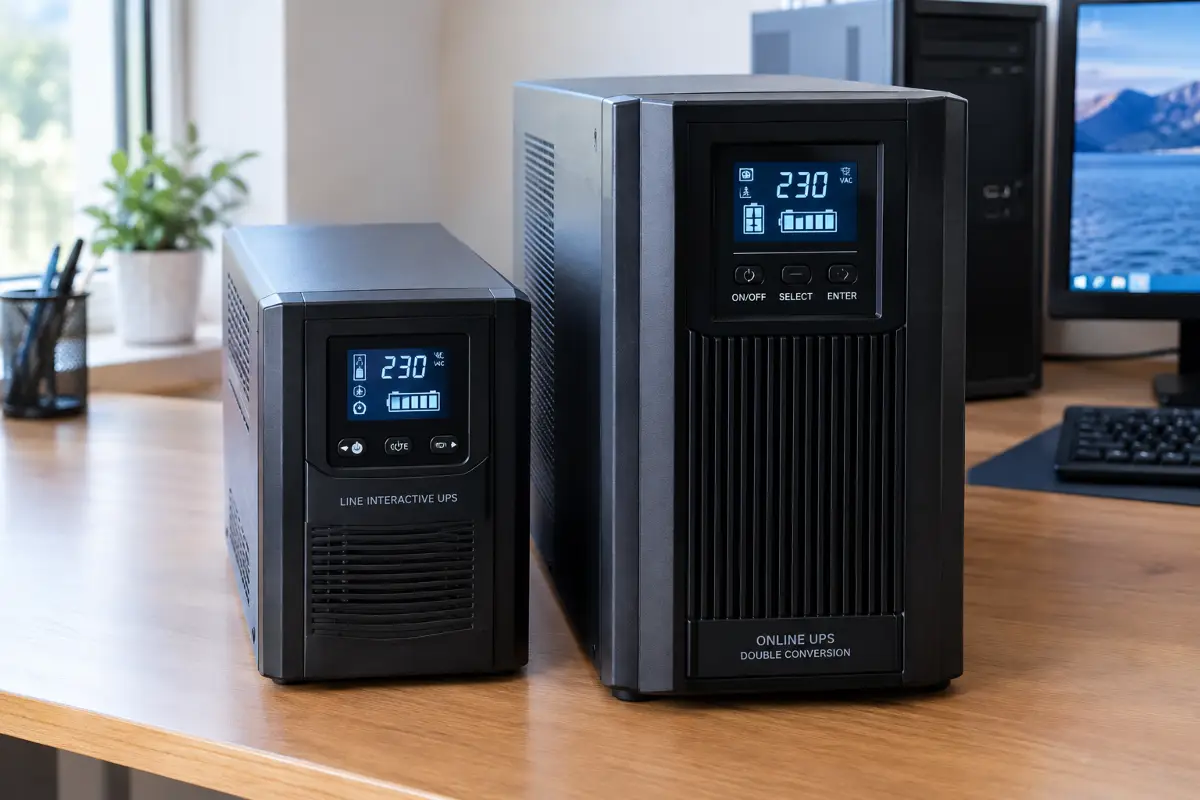
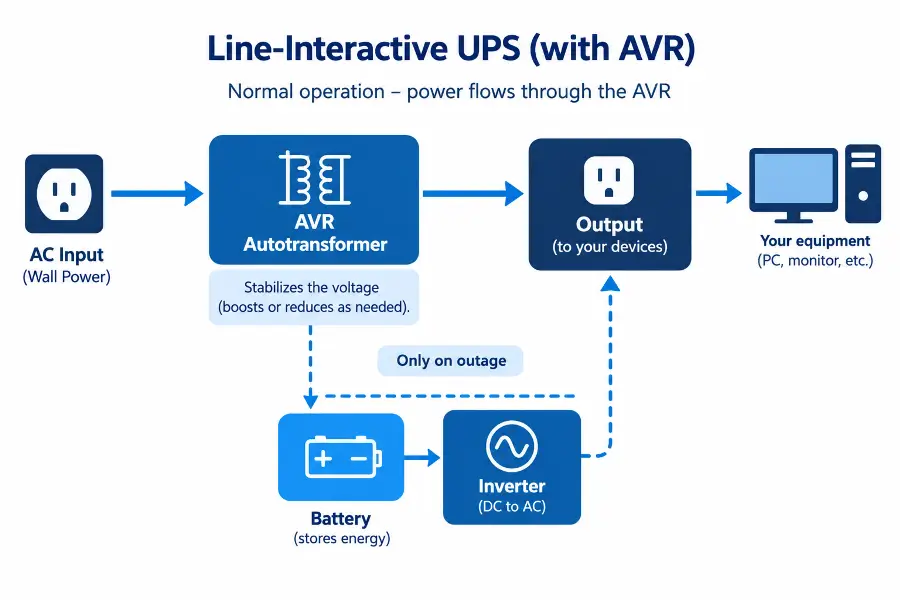
A line-interactive UPS is the type sold in almost every electronics store, usually the cheapest option on the shelf. Under normal conditions, it passes wall power through to your equipment with only minor filtering, while continuously trickle-charging its internal battery. It is called "line-interactive" because of one specific feature: an automatic voltage regulator, or AVR, built from a small autotransformer with multiple taps.
When incoming voltage sags or spikes slightly, the AVR switches taps to correct it, without ever touching the battery. This handles the small, everyday fluctuations that are actually the most common form of "bad power," especially in older buildings or areas with long distribution lines. Only when the voltage drops out completely, or falls far outside the AVR's correction range, does the UPS switch to its inverter and start drawing from the battery.
That switch is not instantaneous. It typically takes somewhere between 2 and 10 milliseconds, depending on the model. For most electronics this gap is invisible because internal capacitors bridge it without any visible interruption. The real story, though, is not the switching time. It is what comes out of the inverter once the battery takes over.
How an Online Double-Conversion UPS Works
An online double-conversion UPS takes a completely different approach, and the name describes exactly what it does. Incoming AC power is first converted to DC, then immediately converted back to AC through the inverter, before it ever reaches your equipment. That conversion happens continuously, all the time, whether the power is stable or not.
This has two direct consequences. First, your equipment is never actually connected to raw wall power at all; it is always running off the inverter's freshly generated output. Second, because the inverter is already running continuously, there is no "switch" to make when the wall power fails. The transfer time is effectively zero, because there was nothing to transfer in the first place.
The trade-off for this constant conversion is cost, size, and heat. Running two full conversion stages non-stop, 24 hours a day, requires a larger transformer, better cooling, and more robust components than a UPS that only kicks in occasionally. That is the core reason online double-conversion units cost noticeably more and run a cooling fan continuously, even when the power is perfectly fine.
Simulated Sine Wave vs Pure Sine Wave
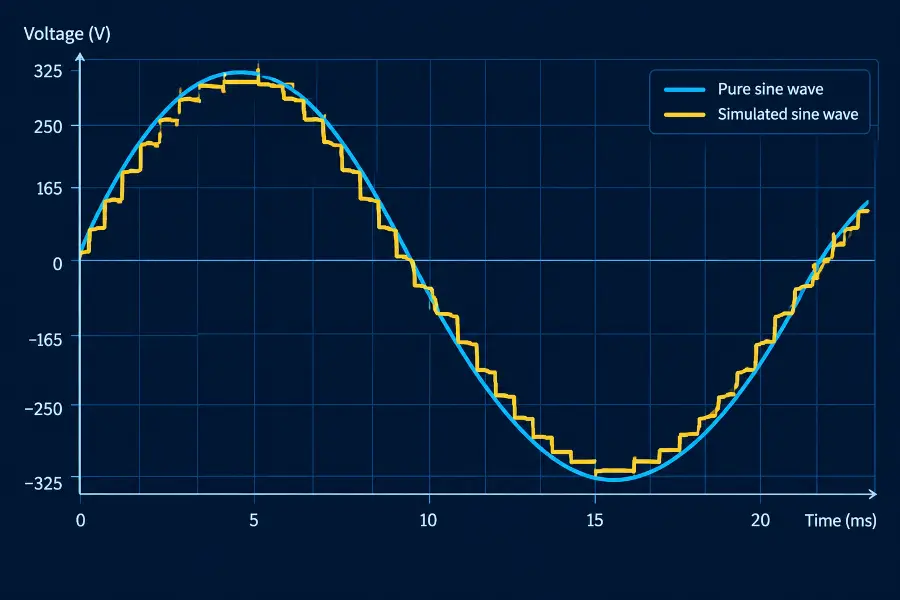
Here is the detail that decides whether your PC survives a power outage gracefully or shuts off mid-task: what shape of electrical wave the UPS produces once it is running on battery. Wall power is a smooth sine wave. Many entry-level line-interactive UPS units, when running on battery, generate a "simulated" or "stepped approximation" sine wave instead: a rough, blocky imitation built from a few voltage steps rather than a smooth curve.
For simple resistive loads like an incandescent lamp, that stepped wave is functionally fine. For a modern computer power supply, it can be a problem. Most PSUs sold in the last decade use Active Power Factor Correction, commonly shortened to Active PFC, a circuit that expects a genuinely smooth sine wave input to regulate current draw correctly. Feed it a stepped wave and the PFC circuit can misread it, causing anything from an audible high-pitched whine, to overheating of the input stage, to the PSU's protection circuitry shutting the whole system down.
An online double-conversion UPS avoids this entirely, because its inverter always outputs a genuine pure sine wave, not just when switching to battery but at all times, since your equipment is always running off that inverter. Higher-end line-interactive models exist too, ones that advertise "pure sine wave" output specifically to solve this exact problem, and they sit in a useful middle ground price-wise.
Why Your PSU Decides Which UPS You Need
The single most useful thing you can do before buying any UPS is check what kind of power supply is already inside your PC. This is a five-minute job and it removes almost all the guesswork.
Active PFC power supplies
The vast majority of PSUs made since roughly 2015, including nearly every 80 Plus certified unit, use Active PFC. Look for "Active PFC" printed directly on the PSU's label, or check the manufacturer's spec sheet if the unit is hidden. These units need a pure sine wave on battery power, full stop.
Passive PFC or non-PFC power supplies
Older or very basic budget PSUs, and most external laptop power bricks, use passive or no PFC at all. These generally tolerate a simulated sine wave without issue, since they are less sensitive to the exact waveform shape.
When in doubt
If the label is worn off or the PSU is unbranded, treat it as Active PFC and plan around a pure sine wave source. The downside of being wrong the safe way is a slightly higher UPS cost; the downside of being wrong the other way is a PC that shuts off during every single outage.
Price Comparison: What You're Actually Paying For
The price gap between the two UPS categories is not marketing markup, it reflects genuinely different internal components. The table below lines up the practical differences for a typical single-PC home setup in the 600 to 1000VA range.
| Aspect | Line-Interactive | Online Double Conversion |
|---|---|---|
| Output waveform (on battery) | Simulated, unless "pure sine wave" model | Always pure sine wave |
| Transfer time | 2-10 ms | 0 ms (always inverting) |
| Typical price, 600-1000VA | Lower | 2-4x higher |
| Noise level | Silent unless on battery | Continuous fan noise |
| Efficiency (mains mode) | Higher, minimal conversion loss | Lower, always converting |
| Battery wear over time | Lower, battery rarely engaged | Higher, inverter runs constantly |
| Best suited for | Single PC, non-PFC or tolerant loads | Active-PFC PSUs, servers, multiple sensitive devices |
The short version: you are not paying extra for a fancier brand name. You are paying for a second permanently-running inverter stage, better cooling, and a genuinely clean waveform at all times, not just an approximation during an outage.
Who Actually Needs Which Type
Not every setup justifies the premium of an online double-conversion unit, and not every budget line-interactive UPS is a mistake. It comes down to what you are protecting and how sensitive it is.
A line-interactive UPS makes sense when
Your PSU is passive PFC or non-PFC, or it is explicitly labeled "pure sine wave" line-interactive.
You are protecting one desktop or a router, not a rack of sensitive gear.
Budget matters more than a zero-millisecond transfer time.
An online double-conversion UPS makes sense when
Your PSU has Active PFC and you want zero risk of shutdown on outage.
You run a home server, NAS, or recording setup that cannot tolerate any interruption.
You are protecting several devices at once, spreading the cost across more value.
There is also a practical middle path worth mentioning: several line-interactive models now ship with genuine pure sine wave inverters while keeping the lower cost and higher efficiency of the line-interactive design. For a single Active-PFC gaming PC, this is often the sweet spot, delivering the one feature that actually matters without paying for zero transfer time you will likely never notice.
My Experience
I tested this directly on my main desktop, which runs an 80 Plus Gold Active-PFC power supply. I first ran it for two weeks on a budget line-interactive UPS with a simulated sine wave output, the kind sold as an entry-level "office" model. During a real outage that lasted about four minutes, the PC shut off within a fraction of a second of the wall power dropping, with no warning and no graceful shutdown. The UPS itself worked fine and kept beeping happily, it was the PSU refusing to accept the stepped waveform that killed the session.
I then swapped in a mid-range line-interactive unit specifically labeled "pure sine wave" and repeated a controlled test by pulling the wall plug while the PC was under a moderate CPU and GPU load. This time the transfer was completely silent from the PC's perspective, no shutdown, no reboot, not even a flicker on the monitor. I measured the switch with a basic multimeter logging voltage and saw the gap sit right around 4 milliseconds, comfortably inside what the PSU's hold-up capacitors could absorb.
For comparison, I also had access to a small online double-conversion unit protecting a home NAS and network switch, and pulled the plug on that circuit the same way. There was genuinely nothing to observe: no click from the UPS, no change on the NAS logs, because the inverter never stopped running in the first place. It is the more expensive option, and for a single gaming PC I would not say it is necessary, but for equipment I cannot afford to reboot unexpectedly, the difference was obvious the moment I tested it.
💬 Comments